
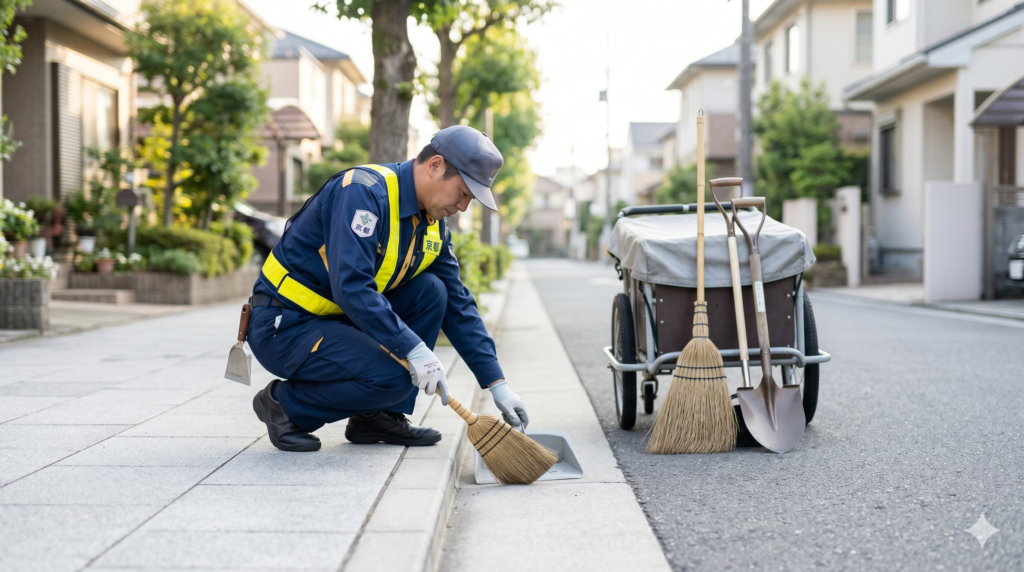
The streets in Japan often look so immaculate that you might think nobody ever set foot on them, let alone cleaned them. This pristine environment is largely thanks to a specialized group of municipal workers known as the “shovel crew.” Tasked with maintaining streets, sidewalks, and public spaces, they do much more than simply pick up trash.
In Japan, cleaning is not just about waste removal; it is an act of restoring a space to its natural, calm state. When the shovel crew finishes a job, there is no dirt, no stray footprints, and no leftover mess. Through a deep respect for shared spaces and strong habits built over time, they ensure the streets look as though they were never dirty to begin with.
2. What is the Shovel Crew?
The shovel crew consists of municipal workers who manage the fine details of street and sidewalk maintenance. While heavy machines are used to clear large areas and handle the bulk of the waste, these workers follow behind with simple tools—shovels, brooms, hand scrapers, and small carts.
They rely on manual labor because it offers a level of control and precision that machines cannot match. Their primary role is to fix the small spots left behind by automated sweepers, ensuring every corner, curb, and gutter is meticulously cared for.
3. Step-by-Step: How Japanese Shovel Crews Clean
To achieve a flawlessly smooth and untouched result, the crews follow a highly disciplined, step-by-step process:
- Initial Debris Removal: Workers first clear visible waste like leaves, trash, mud, and snow. This reveals the surface underneath, allowing them to see exactly what needs detailed attention.
- Edge and Corner Cleaning: Using brooms and shovels, workers target tight spaces like curbs, gutters, and drainage lines where dirt naturally accumulates.
- Surface Sweeping and Refinement: A secondary sweep removes the fine dust left behind by the main cleaning, ensuring a smooth, particle-free surface.
- Precision Detailing: This is the phase that makes the work “invisible.” Workers carefully brush away their own footprints, tool streaks, and marks, smoothing out disturbed gravel or dirt so the ground looks entirely natural.
- Final Inspection: Before moving to the next site, the crew visually inspects the area to catch any missed details, ensuring a consistent finish.
- Waste Collection: All gathered debris is sorted and transported away. Absolutely nothing is left behind on the street.
4. The “Leave No Trace” Principle
At the heart of the shovel crew’s work is the “Leave No Trace” principle. For these workers, a job is not finished just because the trash is gone; it is only complete when no evidence of the cleanup remains.
The ultimate goal is to shift the appearance of the street from looking “recently cleaned” to looking “always clean.” By erasing visual clues of their own effort, the crew leaves behind a space that blends perfectly into its surroundings, feeling permanent and undisturbed.
5. Cultural Foundations Behind the System
Japan’s street cleaning system is built on strong cultural philosophies that shape how citizens view public work and personal responsibility:
- Respect for Public Space: Streets are viewed as shared communal property. Cleaning them is not just a municipal job, but a way to show respect to the community.
- The Kaizen Mindset: Kaizen means continuous, incremental improvement. Workers constantly refine their techniques, looking for smoother, more efficient ways to handle simple tasks.
- Discipline and Craftsmanship: Physical labor is treated with the focus and pride of a craft. Every swing of a broom is deliberate and controlled.
- Collective Responsibility: Cleanliness is supported by the whole of society. Because everyone understands their role, these high standards are maintained consistently across the country.
6. A Work Ethic Beyond “Clean Enough”
Workers in Japan routinely exceed official requirements. Rather than stopping when a street is “clean enough,” they continue until every detail feels fully resolved.
This work ethic is driven by rigorous training and repetition. Over time, workers develop precise habits that allow them to work swiftly without sacrificing quality. There is a quiet pride in executing excellent work—even if no one explicitly notices it. The goal is perfection, not praise.
7. The Global Contrast
While street cleaning happens worldwide, the methodology often differs significantly. In many countries, large, automated sweepers do the heavy lifting. While fast and efficient, machines often miss the fine details—leaving behind dirt in tight corners, streaks on the pavement, or visual signs that a cleaning crew recently passed through.
Japan opts for a hybrid approach. By pairing machine efficiency with manual precision, they prioritize the visual restoration of the street just as highly as the physical removal of waste.
8. The Impact on the Urban Environment
This rigorous attention to detail has a profound ripple effect on Japanese cities:
- Safer, Pleasant Spaces: Parks, sidewalks, and roads always feel fresh and inviting.
- Reduced Litter Accumulation: Because small messes are addressed immediately, they never have the chance to snowball into larger waste problems.
- Positive Civic Behavior: Clean spaces naturally influence human behavior. When citizens see spotless streets, they are much less likely to litter and more likely to take pride in their city.
9. Conclusion: When Cleaning Becomes Culture
The Japanese shovel crew represents far more than just effective municipal maintenance; their work is a form of non-verbal communication. An impeccably clean street quietly signals to everyone that someone cares, silently encouraging the public to treat the space with the same respect.
Cleanliness of this caliber is not an accident. It is the result of discipline, practice, and the deeply ingrained belief that perfection does not come from grand gestures, but from doing small things the right way, day after day. When this level of care becomes a habit, even the simplest street can look effortlessly perfect.