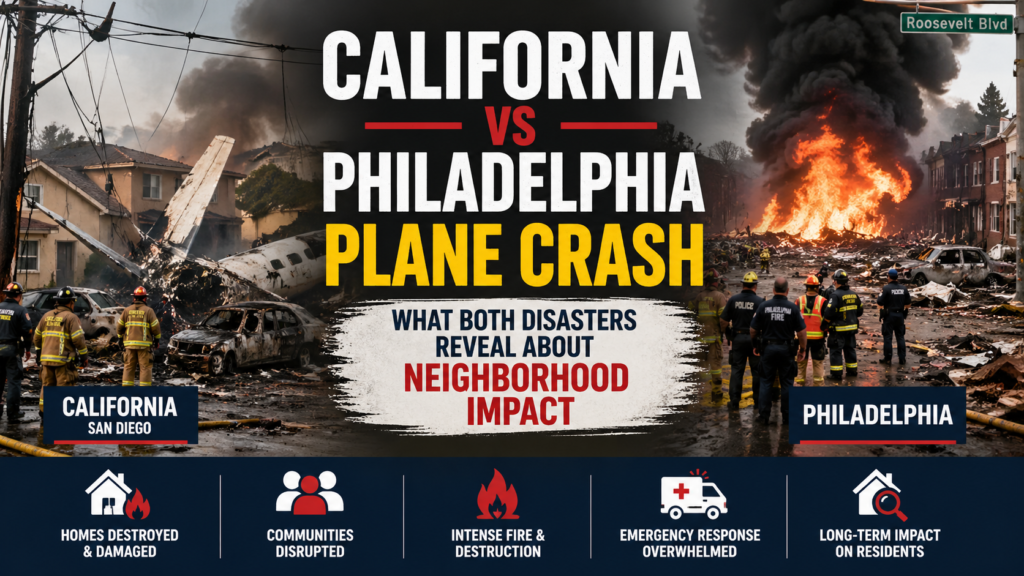
When a plane crashes in a remote area, the tragedy is usually limited to those onboard. But when a crash happens in a neighborhood, the damage spreads much further. That is exactly what happened in the San Diego, California plane crash and Philadelphia plane crashes, two incidents that turned into community disasters rather than isolated aviation accidents.
Both crashes show how quickly small-aircraft incidents can affect people on the ground, destroy property, and overwhelm emergency responders. They also reveal a deeper truth: in populated areas, aviation safety is not just about pilots and passengers. It is also about the people who live beneath flight paths.
A crash becomes a neighborhood crisis
The California crash in San Diego involved a private jet that came down in a military housing neighborhood near the airport. Reports said the plane struck power lines and crashed into homes and vehicles, with residents hurt and extensive debris scattered across the area. The scene was marked by fire, smoke, and the smell of jet fuel long after the crash was contained.
Philadelphia saw a similar pattern, but on a broader scale. The plane crashed in a densely populated area, creating a fireball, a crater, and a debris field that stretched across a wide section of the neighborhood. City officials said hundreds of homes were impacted in some way, while multiple homes were destroyed or severely damaged. That makes the Philadelphia crash one of the clearest examples of how an aircraft accident can become a major urban disaster.
What both crashes had in common
The strongest common thread is that both crashes affected far more than the passengers onboard. In San Diego, nearby residences were damaged and vehicles caught fire. In Philadelphia, the impact zone was even larger, with dozens of homes directly damaged and hundreds more affected in some way.
Both accidents also involved intense fire and physical destruction on the ground. In California, jet fuel spread through the neighborhood and ignited vehicles and property. In Philadelphia, debris exploded into a fireball and created multiple fires that required a large emergency response. In both cases, first responders had to manage a scene that combined aviation disaster, structural fire, and community disruption.
How the impact differed
Although the two crashes shared similar patterns, the Philadelphia crash had a wider community footprint. California’s crash was devastating, but the residential damage was more concentrated around the immediate crash zone. Philadelphia, by contrast, affected a much larger area and required inspections across a broader section of the neighborhood.
The cleanup burden was also different. In San Diego, families were displaced and emergency aid was focused on short-term recovery. In Philadelphia, residents continued dealing with structural concerns and property damage long after the crash. That made the Philadelphia incident a longer-lasting neighborhood disruption.
Why these crashes matter
These disasters are reminders that aviation incidents in urban areas are never just aviation incidents. They can damage homes, injure civilians, disrupt daily life, and leave lasting environmental and structural problems behind. The danger is not only in the aircraft’s descent, but in what the aircraft strikes on the way down.
They also raise questions about flight paths, airport proximity, and emergency preparedness in densely populated communities. When a plane goes down near homes, the risk multiplies instantly. That is why both the California and Philadelphia crashes became public safety emergencies as much as aviation tragedies.
Final thought
The California and Philadelphia plane crashes share one clear lesson: small aircraft accidents can create very large human consequences when they happen in neighborhoods. The damage goes beyond the wreckage itself and reaches families, homes, and entire communities. That is what makes these crashes so unsettling, and why they deserve attention not only as news stories, but as warnings about the risks of flying over populated areas.
FAQ
What is the main similarity between the California and Philadelphia plane crashes?
Both crashes happened in populated areas and caused damage beyond the aircraft itself, including injuries to people on the ground and destruction of nearby property.
Which crash had the bigger impact?
The Philadelphia crash had the wider impact overall, with more homes affected and a larger cleanup and recovery burden.
Why are neighborhood plane crashes so dangerous?
They are dangerous because the crash can hit houses, vehicles, power lines, roads, and civilians, making the impact much larger than the loss of the aircraft alone.
Did both crashes involve fire?
Yes. Both crashes involved fire and debris, which increased the risk to residents and emergency responders.
What lesson do these crashes teach?
They show that aviation safety is also a community safety issue, especially when aircraft fly near dense residential areas.