
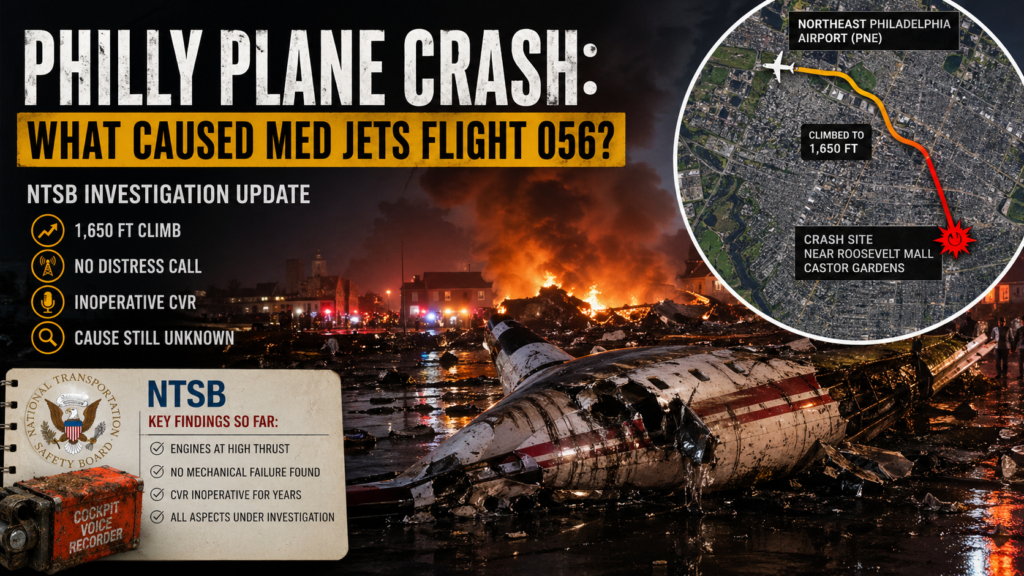
Just 40 seconds after take-off, a medevac jet plummeted into Philadelphia’s Castor Gardens, killing 8 people and injuring 22—yet the National Transportation Safety Board still cannot confirm exactly why it happened. The Philly plane crash involving Med Jets Flight 056 remains one of the most shocking aviation incidents in recent years.
Early data reveals chilling details: the aircraft climbed only 1,650 feet, made sudden turns, issued no distress call, and had an inoperative Cockpit Voice Recorder (CVR). These gaps have left investigators piecing together a complex puzzle.
So, what does the NTSB actually know—and what remains a mystery—about the Med Jets Flight 056 crash? This article breaks down the latest findings, key facts, and ongoing investigation into the NTSB cause behind this tragedy.
Incident Overview

On January 31, 2025, a Learjet 55 operated by Jet Rescue Air Ambulance departed from Northeast Philadelphia Airport at 6:06 PM ET. The flight was heading toward Tijuana, Mexico, with a planned refuelling stop in Missouri.
Key Timeline Events:
- Takeoff at 6:06 PM
- Rapid climb to ~1,650 feet
- Abrupt turns shortly after departure
- Sudden descent exceeding 11,000 feet per minute
- Crash near Roosevelt Mall
The aircraft, built in 1982, was on a medical evacuation mission carrying:
- A pediatric patient
- The patient’s mother
- Two pilots
- Two medical crew members
Ground Impact
The crash caused massive destruction in the Castor Gardens neighborhood:
- Fires and explosions erupted immediately
- A large crater formed at the crash site
- Nearby homes and vehicles were damaged
Tragically, two people on the ground—identified as Steven Dreuitt and Dominique Goods-Burke—lost their lives.
Victims and Community Impact
This devastating Philly plane crash affected both passengers and residents on the ground.
Casualty Breakdown
| Category | Details |
| Onboard Fatalities | 6 (patient, mother, 2 pilots, 2 crew) |
| Ground Fatalities | 2 (vehicle occupants) |
| Injuries | 22 (ranging from minor to serious) |
Among the victims was 11-year-old Valentina Guzman Murillo, whose story became a symbol of the tragedy’s emotional toll.
Community Response
The local community rallied together in the aftermath:
- Emergency responders acted within minutes
- Dozens of families were displaced
- Memorial events were held in January 2026
City officials, including Mayor Cherelle Parker, praised first responders for their rapid action and commitment during the crisis.
NTSB Preliminary Findings
The NTSB cause has not yet been finalized, but early findings provide important clues.
Key Data Points:
- Engines were producing high thrust before impact
- No immediate evidence of mechanical failure
- Weather conditions included light rain and wind gusts up to 26 knots
Flight Behavior:
- Climbed to 1,650 feet
- Performed multiple directional changes
- Entered a steep 22-degree descent
Recorder Issues
One of the biggest obstacles in the investigation:
- The Cockpit Voice Recorder (CVR) had been inoperative for years
- No cockpit audio is available for analysis
- Enhanced Ground Proximity Warning System (EGPWS) data is still under review
Additional Findings:
- No distress call was made to air traffic control
- Debris scattered across a wide area
- Engines were sent to Delaware for detailed examination
- Investigators reviewed 23+ witness accounts and surveillance footage
Why No Final NTSB Cause Yet?
A major question remains: why hasn’t the NTSB determined the cause?
Investigation Timeline
Aircraft accident investigations typically take 12 to 24 months. As of April 2026, the Med Jets Flight 056 case (Docket: ERA25MA106) is still active at around 15 months.
Key Challenges:
- Lack of CVR audio limits insight into pilot decisions
- Ongoing lab testing of engines and systems
- Complex flight behavior requiring detailed reconstruction
The NTSB has stated that “all aspects remain under investigation,” meaning no official probable cause has been released yet.
Leading Theories and Speculation
While no conclusions have been confirmed, several possible factors are being discussed:
1. Automation or Control Malfunction
A sudden issue during climb-out could have caused loss of control.
2. Spatial Disorientation
Poor weather conditions may have affected pilot perception and response.
3. Operational or Maintenance Factors
The aircraft’s age and operator history are under review.
4. Legal Developments
Some lawsuits claim the crash was preventable, but legal outcomes depend on the final NTSB report.
⚠️ It’s important to avoid jumping to conclusions. All theories remain speculative until the NTSB releases its final findings.
Investigation Updates and What’s Next
Key Milestones:
- CVR recovered: February 2, 2025
- Preliminary report released: March 6, 2025
- Ongoing analysis into 2026
What to Expect:
- Final report with probable cause
- Safety recommendations for aviation industry
- Potential regulatory updates for medevac operations
You can track updates directly through the official NTSB docket (ERA25MA106).
Conclusion: A Tragedy Still Without Answers
The Philly plane crash involving Med Jets Flight 056 remains a heartbreaking event with many unanswered questions. Despite strong clues—like high engine thrust, unusual flight behavior, and missing CVR data—the NTSB cause is still undetermined.
As the investigation continues, the aviation world—and the families affected—await clear answers.
What Do You Think?
Do you believe this crash was caused by human error, technical failure, or something else entirely?
👉 Share your thoughts in the comments
👉 Share this article with others
👉 Subscribe for more aviation updates and deep-dive reports
Stay informed. The final answer is coming—but not yet.
To read more similar stories, click here,