If you’ve heard the term “504 Plan” and felt a bit lost, you’re not alone. It shows up a lot in school conversations, especially around learning support—but it’s not always clearly explained.
Here’s a simple, complete breakdown of what a 504 Plan is, who it helps, and how it actually works in schools.
What Is a 504 Plan?
A 504 Plan is a support plan used in U.S. public schools to make sure students with disabilities have equal access to education.
It comes from Section 504 of the Rehabilitation Act of 1973, a civil rights law that prevents discrimination against people with disabilities in programs that receive federal funding (including public schools).
In simple terms:
A 504 Plan makes school fair by removing barriers—not changing what is taught, but how a student accesses it.
What Does a 504 Plan Actually Do?
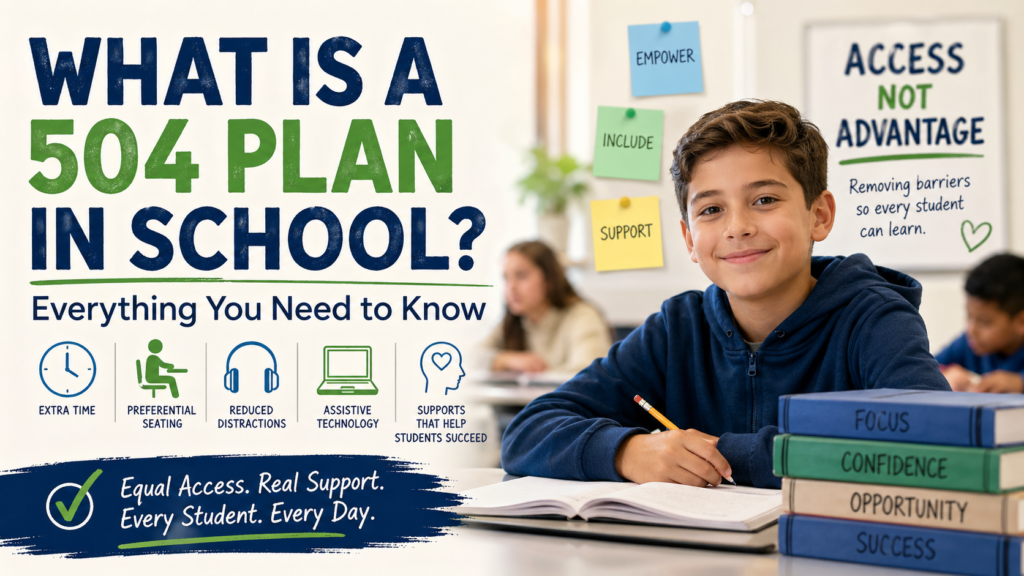
A 504 Plan provides accommodations, not specialized instruction.
That means students stay in general education classrooms, but receive support such as:
- Extra time on tests
- Preferential seating (like sitting near the teacher)
- Breaks during long assignments
- Assistive technology (text-to-speech, audio tools)
- Reduced distractions (quiet room or headphones)
The goal is simple: level the playing field so students can learn effectively.
Who Qualifies for a 504 Plan?
A student may qualify if they have a physical or mental condition that significantly affects major life activities, such as:
- Learning
- Reading
- Concentration
- Hearing or seeing
- Walking or self-care
Common examples include:
- ADHD
- Diabetes
- Asthma
- Anxiety disorders
- Severe allergies
- Temporary injuries (like recovery after surgery)
Importantly, a formal medical diagnosis is helpful but not always required—schools evaluate each case individually.
How a 504 Plan Is Created
The process usually looks like this:
1. Request for Evaluation
A parent, teacher, or school staff member requests a review.
2. School Evaluation
A team reviews the student’s needs. This often includes:
- Teachers
- School administrators
- Counselors
- Parents
3. Plan Development
If the student qualifies, the team creates a plan tailored to their needs.
4. Implementation
Teachers follow the accommodations in daily classroom activities.
5. Annual Review
The plan is reviewed at least once a year and updated if needed.
504 Plan vs IEP: What’s the Difference?
This is one of the most common points of confusion.
| Feature | 504 Plan | IEP (Individualized Education Program) |
| Law | Civil Rights Law | Special Education Law |
| Support Type | Accommodations only | Accommodations + specialized instruction |
| Placement | General classroom | May include separate special classes |
| Eligibility | Broader definition of disability | Specific disability categories |
| Intensity | Less intensive support | More structured support |
In short:
- 504 Plan = Access support
- IEP = Instruction + support
Real Examples of 504 Accommodations
Here are some common classroom supports:
- Sitting near the front of the classroom for focus
- Extra time on exams or assignments
- Frequent short breaks during long tasks
- Use of laptops or speech-to-text tools
- Modified homework load when needed
These adjustments don’t lower expectations—they help students meet them.
Legal Protection Behind 504 Plans
Because it comes from federal civil rights law, schools are required to:
- Provide equal access to education
- Avoid discrimination based on disability
- Offer “Free Appropriate Public Education” (FAPE)
If parents disagree with a school decision, they can file a complaint with the Office for Civil Rights (OCR).
Why 504 Plans Matter
At their core, 504 Plans are about access and fairness.
They recognize that:
- Not all students learn the same way
- Barriers can exist even in regular classrooms
- Small adjustments can make a big difference
For many students, a 504 Plan is the difference between struggling silently and actually succeeding in school.
Final Thoughts
A 504 Plan isn’t about giving students an advantage—it’s about removing obstacles so they can participate equally in education.
If you remember one thing, let it be this:
A 504 Plan helps students access learning in a way that works for them—not change what they are capable of learning.
FAQ
Is a 504 Plan special education?
No. It is not special education—it provides accommodations in general education.
Can ADHD qualify for a 504 Plan?
Yes, ADHD is one of the most common conditions that qualifies.
Do 504 Plans follow students to college?
Not automatically, but colleges may provide similar accommodations through disability services.