
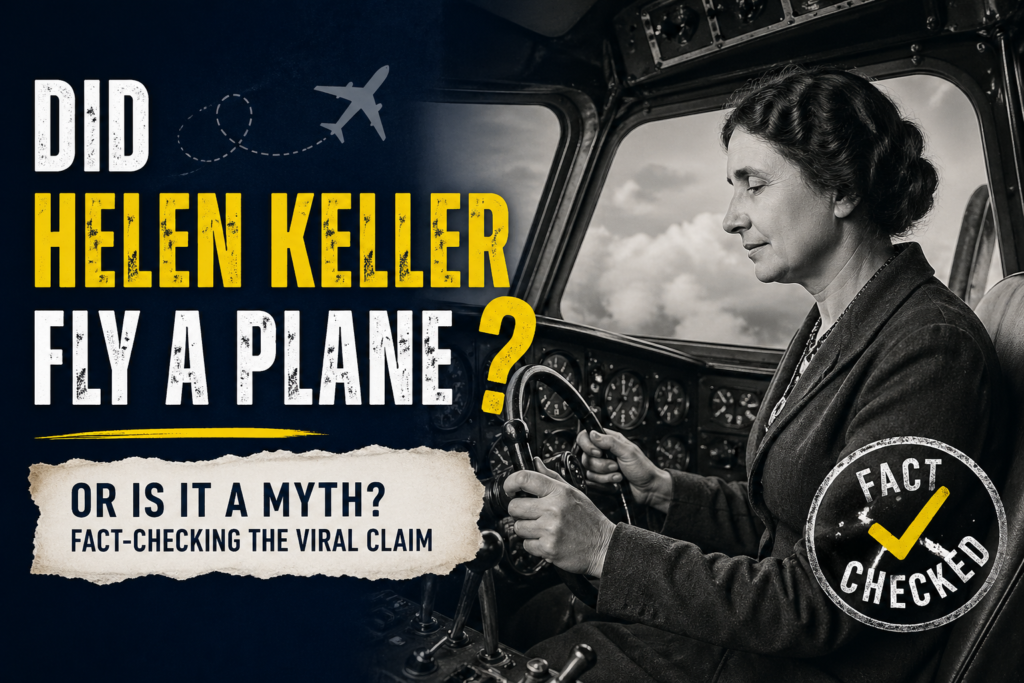
Why This Question Keeps Coming Back
Every few months, the internet rediscovers the same question:
Did Helen Keller really fly a plane—or is that just another exaggerated story?
Some people find it inspiring. Others call it impossible. And with social media amplifying skepticism, the claim often gets dismissed as a myth.
So what’s the truth?
Let’s break it down carefully—using historical records, context, and a bit of common sense.
Short Answer: Did Helen Keller Fly a Plane?
Yes—but not in the way many people imagine.
Helen Keller did briefly control an airplane during a flight in 1946. However:
- She was not a licensed pilot
- She was not flying independently
- She was guided by a professional pilot, with instructions relayed through her interpreter
So the story is real, but often misrepresented.
The Origin of the Story
The 1946 Flight
The event took place in June 1946, when Helen Keller was traveling from Rome to Paris.
She was aboard a Douglas C-54 Skymaster, a four-engine aircraft commonly used after World War II.
This wasn’t a stunt or publicity event—it was a regular flight during one of her international trips.
Who Was With Her?
Helen Keller wasn’t alone. She was accompanied by:
- Her interpreter, Polly Thomson
- A trained pilot and full flight crew
This detail matters because it explains how communication and safety were handled.
What Actually Happened in the Cockpit
At some point during the flight, the pilot invited Keller into the cockpit.
Here’s what followed:
- She sat in the co-pilot’s seat, Helen Keller flying a plane.
- She was allowed to hold the controls (the yoke and possibly throttles)
- Instructions were passed to her via tactile sign language
- She interacted with the aircraft for approximately 20 minutes
Keller later described the experience as feeling:
“the delicate movement of the aircraft through the controls”
That’s a key detail—it shows she wasn’t guessing. She was actively sensing the aircraft’s motion.
How Was This Even Possible?
This is where most skepticism comes from. Let’s break it down.
Tactile Communication
Helen Keller communicated through touch-based sign language.
In this situation:
- The pilot gave instructions to Polly Thomson
- Thomson translated them into tactile signals in Keller’s hand
This allowed Keller to understand:
- Directional adjustments
- Control inputs
- Timing and movement
Feeling the Aircraft
Flying isn’t purely visual—it’s also physical.
Pilots rely on:
- Pressure in the controls
- Movement and vibration
- Changes in resistance
Keller could feel:
- The aircraft responding to inputs
- Subtle shifts in motion
This made limited control possible—especially under supervision.
Why People Think It’s a Myth
1. It Sounds Unreal
A deaf-blind person flying a plane challenges assumptions. Most people instinctively think:
“That can’t be real.”
But unlikely doesn’t mean impossible—especially with assistance.
2. Misleading Headlines
A big part of the confusion comes from wording.
There’s a huge difference between:
- “Helen Keller flew a plane”
- “Helen Keller briefly held the controls under supervision”
The first sounds dramatic. The second is accurate.
3. Social Media Amplification
Platforms like TikTok and Twitter often turn nuanced facts into:
- Oversimplified claims
- Viral debates
- False “debunks”
Once skepticism spreads, it becomes hard to separate fact from noise.
Myth vs Reality
| Claim | Reality |
|---|---|
| Helen Keller was a licensed pilot | ❌ No |
| She flew a plane completely on her own | ❌ No |
| She briefly controlled the aircraft | ✅ Yes |
| She was guided by a trained pilot | ✅ Yes |
| The event is historically documented | ✅ Yes |
What Do Historical Sources Say?
Multiple credible sources confirm the event, including:
- Reports from the American Foundation for the Blind
- Contemporary newspaper coverage
- Consistent historical accounts
These sources agree on the key details:
- The flight happened
- Keller interacted with the controls
- She was guided throughout
There’s no serious evidence suggesting the story was fabricated.
Could This Happen Today?
Aviation Rules
Modern aviation regulations are clear:
- Hearing-impaired individuals can become pilots (with certain limitations, like no radio use in some cases)
- Full blindness, however, prevents pilot certification
So no—Keller wouldn’t be able to become a licensed pilot today either.
Similar Modern Examples
There have been cases where:
- Deaf-blind individuals participated in guided flight experiences
- Students used instructors and assistive communication
These examples reinforce that what Keller did—under supervision—is entirely plausible.
Why This Story Still Matters
The real value of this story isn’t in exaggeration.
It’s in what it shows:
- Human adaptability is often underestimated
- Complex tasks can be broken down and guided
- Sensory limitations don’t eliminate capability—they change how it works
Keller didn’t perform a miracle. She demonstrated skill, trust, and communication.
Final Verdict: Myth or Fact?
Fact—with important context.
Helen Keller did not fly a plane independently.
But she did take control of the aircraft briefly, under expert supervision.
The myth isn’t that it happened.
The myth is how dramatically it’s sometimes told.
FAQ
Did Helen Keller really fly a plane?
Yes, she briefly controlled an aircraft during a supervised flight in 1946.
How long did she control the plane?
Approximately 20 minutes.
Was she alone in the cockpit?
No, she was accompanied by a pilot and her interpreter.
How did she receive instructions?
Through tactile sign language communicated by her interpreter.
Final Thought
Sometimes the truth is more interesting than the myth—not because it’s exaggerated, but because it’s real.
And in this case, the real story holds up just fine.