Why Technology and Creativity Must Work Together
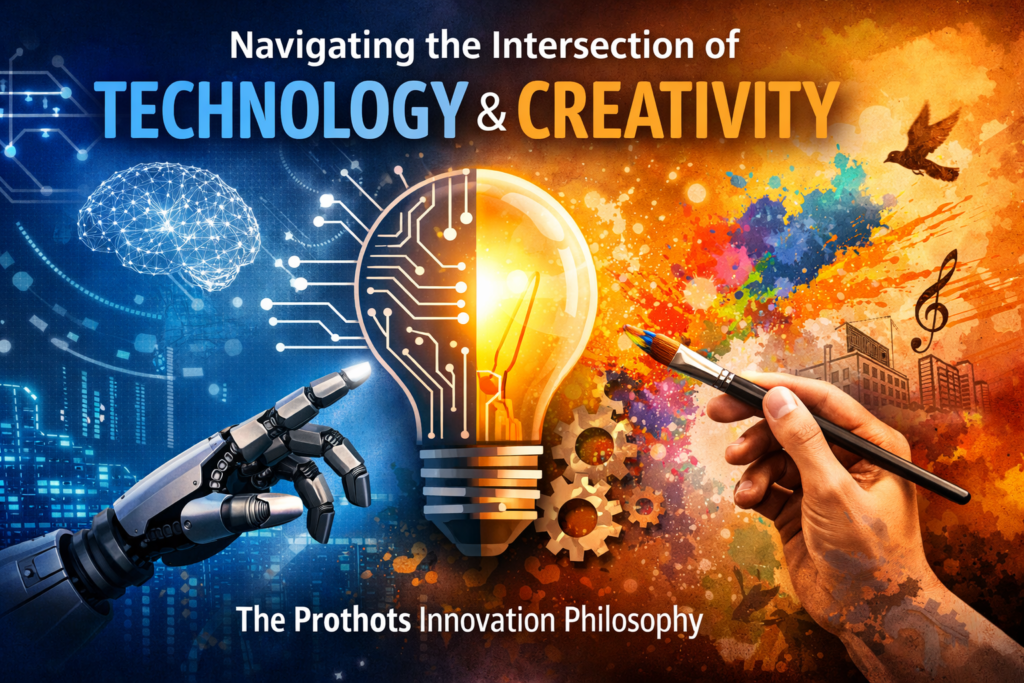
In today’s fast-evolving digital world, innovation no longer happens in isolation. The most impactful breakthroughs emerge where technology meets creativity. From artificial intelligence generating artwork to intelligent design tools accelerating engineering workflows, modern innovation is defined by collaboration between human imagination and advanced systems.
This growing shift has given rise to a new concept: Prothots — a philosophy that represents the fusion of thought and technology to unlock new possibilities. Rather than replacing human creativity, technology is becoming a powerful partner that enhances how we ideate, design, and innovate.
Understanding this intersection is essential for professionals, businesses, and creators seeking to stay relevant in the era of intelligent transformation.
What is Prothots? Definition and Meaning
Prothots is an emerging innovation philosophy that emphasizes collaboration between human creativity and intelligent technological systems.
It reflects a mindset where advanced tools are used to amplify imagination rather than constrain it.
Key Components of Prothots
- Human creativity and emotional intelligence
- Artificial intelligence and computational analysis
- Collaborative innovation workflows
- Tool-driven execution of ideas
Together, these elements form a framework that redefines how innovation is approached in the modern era.
The Role of Artificial Intelligence in Creative Innovation
Artificial intelligence has evolved beyond simple automation. Today, AI systems can:
- Generate visual art and music
- Assist in architectural and product design
- Analyze market trends for creative strategies
- Support scientific discovery through pattern recognition
Although machines do not possess emotional understanding, their analytical capabilities provide new sources of inspiration. This enables creators to explore ideas that were previously difficult or impossible to execute.
As a result, AI is transforming creativity from an individual effort into a collaborative process between humans and machines.
Technology as a Creative Enabler Across Industries
The intersection of creativity and technology is reshaping multiple sectors:
Engineering and Product Design
Advanced digital platforms now offer intelligent design assistance, enabling engineers to focus more on innovation rather than repetitive technical tasks.
Healthcare Innovation
AI-driven diagnostics combine human medical expertise with predictive analytics to improve patient outcomes and treatment accuracy.
Smart Homes and IoT
Connected devices are redefining user experience by responding intuitively to human needs, blending functionality with design creativity.
Business and Customer Experience
Companies increasingly rely on user-driven innovation models, integrating real-time feedback into product development cycles.
These examples demonstrate that creative-technology collaboration is becoming a universal driver of progress.
The Prothots Innovation Framework: A Practical Approach
To apply this philosophy effectively, organizations and individuals can follow a structured innovation model:
1. Idea Generation
Leverage human creativity, curiosity, and domain expertise to develop original concepts.
2. AI-Assisted Exploration
Use intelligent tools to simulate possibilities, analyze data, and refine ideas.
3. Iterative Experimentation
Test and validate concepts through digital platforms that support rapid prototyping.
4. Feedback Integration
Incorporate user insights and analytical data to enhance relevance and effectiveness.
5. Scalable Implementation
Transform validated ideas into scalable solutions that deliver real-world impact.
This framework ensures that creativity is supported by systematic technological advancement.
Why Human-Centered Innovation Matters
Modern innovation is increasingly guided by human needs and experiences. Businesses and creators recognize that technological progress must align with real-world value creation.
Customer-centric development models emphasize listening, learning, and adapting. This approach aligns with the Prothots philosophy by combining analytical intelligence with empathetic design thinking.
Ultimately, meaningful innovation occurs when solutions are both technologically advanced and emotionally resonant.
Future Trends in Technology-Driven Creativity
The next phase of innovation will be shaped by several transformative trends:
- Generative AI enabling new creative industries
- Cognitive augmentation tools enhancing human decision-making
- Automation reducing routine workloads
- Hybrid intelligence ecosystems integrating human and machine expertise
- Cross-disciplinary innovation becoming the norm
These developments indicate that the future workforce will require both technical literacy and creative adaptability.
How to Apply Prothots in Everyday Work
Individuals across professions can adopt this mindset by:
- Using AI tools for brainstorming and idea expansion
- Treating technology as a collaborative partner
- Developing interdisciplinary skills combining creativity and analytics
- Embracing experimentation and continuous learning
- Integrating user feedback into creative processes
By doing so, professionals can remain competitive in an increasingly intelligent digital economy.
Conclusion: The Future Belongs to Collaborative Intelligence
The convergence of technology and creativity represents one of the most significant transformations of our time. The Prothots philosophy encourages us to move beyond viewing machines as mere tools and instead recognize them as partners in innovation.
As intelligent systems become more integrated into everyday workflows, the ability to combine imagination with technological capability will define success.
The future of innovation is not about choosing between human creativity and machine intelligence.
It is about harnessing both to build solutions that redefine what is possible.